
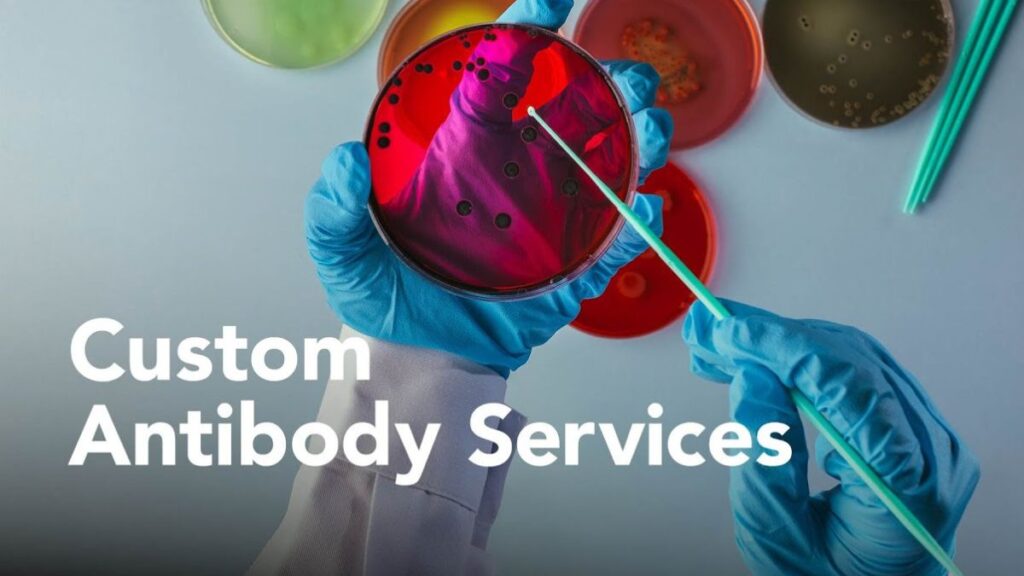
Antibodies remain one of the most important tools in biological research, diagnostics, and therapeutic discovery. They help researchers detect proteins, study signaling pathways, validate biomarkers, develop assays, and investigate disease mechanisms. But even with thousands of commercial antibodies available, many projects still require a more tailored solution.
Some targets are too new, too rare, too species-specific, or too difficult for standard catalog antibodies. In other cases, an available antibody may not work in the required application, may show high background, or may lack the consistency needed for long-term studies. This is where custom antibody services become useful.
A strong custom antibody workflow helps researchers move from target selection to usable antibody reagent through antigen design, host selection, immunization, screening, purification, and validation. The goal is not simply to produce an antibody. The goal is to develop one that performs reliably in the intended assay.
Why Custom Antibody Development Is Still Needed
Commercial antibodies are convenient, but they do not solve every research problem. Many researchers still face gaps when studying novel biomarkers, low-abundance proteins, rare species, discontinued antibodies, or targets that require highly specific detection.
A catalog antibody may work well for Western blot but fail in immunohistochemistry. Another may detect the target in human samples but not in mouse, rat, zebrafish, plant, or other model systems. Some antibodies may bind the right protein but create too much background for clean imaging or quantification.
Custom antibody development gives researchers more control over the process. Instead of adapting the experiment to an available antibody, the antibody can be designed around the research objective.
Key Applications of Custom Antibody Services
Custom antibody services are used across research, diagnostic, and early therapeutic development workflows. The right production strategy depends on the target, required specificity, application, timeline, and budget.
Research-Use Antibodies
For basic research, custom antibodies are often used when commercial options are unavailable or unreliable. These projects may involve protein detection, pathway analysis, localization studies, immunoprecipitation, or model organism research.
In these cases, the priority is usually practical performance. Researchers need an antibody that can produce a clean, usable result in the assay they care about most.
Diagnostic Antibody Development
Diagnostic applications require stronger consistency and specificity. Antibodies used in diagnostic assays may need to perform across many samples, conditions, and production batches.
For these projects, monoclonal or recombinant antibody platforms are often preferred because they provide better long-term reproducibility than standard polyclonal formats.
Therapeutic Discovery Support
Custom antibody development can also support early therapeutic discovery. These projects may require antibodies with high affinity, strong specificity, functional activity, or compatibility with downstream engineering.
While research-use antibodies may be evaluated mainly by assay performance, therapeutic-facing projects often require more detailed screening and candidate selection.
Main Types of Custom Antibody Production Platforms
Different antibody platforms solve different problems. Choosing the right one early can reduce delays and avoid wasted validation work.
Custom Polyclonal Antibodies
Polyclonal antibodies are produced from a mixed population of antibody-producing cells. Because they recognize multiple epitopes on the same antigen, they can provide strong signal and useful sensitivity.
This makes them a practical choice for research-use projects, especially when the target is difficult to detect or when fast, cost-effective production is important. Polyclonal antibodies are commonly used in Western blot, IHC, IP, ELISA, and other standard research applications.
The trade-off is batch variability. Since polyclonal antibodies come from a biological serum response, long-term reproducibility may be more limited than monoclonal or recombinant options.
Custom Mouse Monoclonal Antibodies
Mouse monoclonal antibodies are developed through hybridoma technology. They recognize a single epitope, which gives them stronger specificity and consistency than polyclonal antibodies.
This makes them useful for diagnostic development, reproducible research assays, flow cytometry, IHC, IF, Western blot, immunoprecipitation, and antibody pair screening. Boster lists mouse monoclonal antibody production as one of its custom service options, with applications including IHC, IF, Flow, WB, IP, and MassSpec.
The main limitation is timeline. Monoclonal development usually takes longer than polyclonal production because it requires clone generation, screening, selection, and expansion.
Recombinant Rabbit Monoclonal Antibodies
Rabbit monoclonal antibodies are often selected when high affinity and strong sensitivity are needed. Rabbits can generate strong immune responses against certain targets, including epitopes that may be less immunogenic in mice.
Recombinant production also improves long-term consistency because the antibody sequence is defined and can be reproduced without relying on the original biological source.
This platform is useful for advanced research, diagnostic development, and programs that may eventually require antibody engineering.
Nanobody Discovery
Nanobodies are single-domain antibodies derived from heavy-chain-only antibodies. Their small size, stability, and binding properties make them useful in imaging, structural biology, intracellular targeting research, and certain assay development workflows.
Boster includes nanobody discovery among its custom antibody service options for projects that require high-affinity single-domain antibodies.
Antigen Design as the Foundation of Antibody Success
The success of a custom antibody project often depends on antigen design. A strong immunogen can improve the chance of producing antibodies with useful specificity and signal. A weak or poorly selected antigen can lead to low titers, poor binding, or unwanted cross-reactivity.
Common antigen formats include peptides, recombinant protein fragments, full-length proteins, and cell or tissue lysates. Each has advantages and limitations.
Peptide antigens are useful when a specific linear epitope is desired. Recombinant proteins can better represent larger target regions and may improve immunogenicity. Full-length proteins can be useful for broader recognition, while lysates may be used in certain monoclonal screening strategies.
Boster’s page notes that researchers can provide antigen directly, provide the exact sequence for synthesis, or share the biomarker so the antigen can be designed for the project.
Choosing the Right Host Species
Host selection affects the immune response, antibody affinity, downstream compatibility, and assay design.
Mouse and rabbit are the most common hosts, but other hosts may be useful depending on the project. For multiplex staining, researchers may need antibodies raised in different host species so they can separate signals using species-specific secondary antibodies.
Rabbit antibodies are often valued for affinity and sensitivity. Mouse monoclonals remain widely used because hybridoma technology is established and practical for reproducible antibody production. Other hosts such as goat, chicken, guinea pig, or llama may be selected for specific experimental needs.
The best host is not always the most advanced option. It is the one that matches the application, sample type, target biology, and validation plan.
Screening and Validation in Custom Antibody Workflows
Producing antibodies is only part of the process. Screening and validation determine whether the antibody is actually useful.
Titer Testing
Titer testing helps confirm that the host has generated an immune response against the antigen. This is an early quality checkpoint in immunization-based antibody production.
A strong titer does not guarantee assay success, but it helps determine whether the project is moving in the right direction.
Specificity Testing
Specificity testing helps confirm that the antibody recognizes the intended target and does not strongly bind unrelated proteins. Depending on the project, this may involve ELISA screening, Western blot analysis, peptide competition, knockdown or knockout validation, or testing against related proteins.
Specificity matters most when targets belong to protein families with high sequence similarity.
Application-Based Validation
An antibody that works in one assay may not work in another. This is why application-based validation is critical.
Western blot requires recognition of denatured protein. IHC and IF may require recognition of fixed tissue or cell structures. Flow cytometry often requires recognition of native surface epitopes. ELISA requires binding under plate-based assay conditions.
A good custom antibody service should define the intended application early so screening can prioritize the right performance profile.
How Custom Antibody Services Reduce Research Risk
Custom antibody projects carry some uncertainty. Biology is not fully predictable, and not every target generates an ideal antibody response. However, risk can be reduced through better planning.
The strongest workflows usually include:
Clear target review
Careful antigen design
Appropriate host selection
Defined production platform
Regular project updates
Purification and QC
Application-specific validation
Transparent reporting
Boster’s custom antibody page describes a workflow where the provider produces the antibody over several months, shares regular project progress updates, and delivers the antibody with a final QC report. It also notes that additional validations such as WB, IHC, ELISA, and Flow can be ordered.
What to Consider Before Starting a Custom Antibody Project
Before choosing a provider or platform, researchers should define the project requirements clearly.
The most important questions include:
What is the target protein?
Which species will be tested?
Is cross-reactivity desired or unwanted?
Which application matters most?
Is long-term reproducibility required?
Is the antibody for RUO, diagnostic, or therapeutic-facing work?
Is speed, cost, sensitivity, or consistency the top priority?
These answers help determine whether the project should use polyclonal production, mouse monoclonal development, recombinant rabbit monoclonal discovery, nanobody discovery, or another approach.
Comparing Cost, Timeline, and Reproducibility
Every custom antibody platform involves trade-offs.
Polyclonal antibodies are usually faster and more affordable, but may have more batch-to-batch variability. Mouse monoclonal antibodies take longer and cost more, but offer better reproducibility. Recombinant monoclonals require more investment but can provide strong consistency and defined sequence control.
Boster’s page compares several antibody production routes, including polyclonal, hybridoma monoclonal, rabbit recombinant monoclonal, and phage display, and notes that platform choice should depend on cost, application, target difficulty, and intended use.
The right choice depends on the value of the antibody to the project. For a short-term exploratory study, a polyclonal antibody may be enough. For a diagnostic assay or long-term biomarker program, monoclonal or recombinant development may be more suitable.
Conclusion
Custom antibody services help researchers solve problems that catalog antibodies cannot always address. Whether the challenge is a rare target, poor commercial validation, species specificity, discontinued supply, or assay-specific performance, custom development allows the antibody strategy to be built around the research goal.
A successful custom antibody project starts with antigen design and continues through host selection, antibody generation, screening, purification, QC, and validation. Each step affects the final result.
For researchers working on difficult targets or high-value assays, custom antibody development can provide a more reliable path toward specific, reproducible, and application-ready antibody reagents.
FAQs
What are custom antibody services?
Custom antibody services help researchers develop antibodies against specific targets when commercial antibodies are unavailable, unsuitable, discontinued, or not validated for the required application.
When should researchers use custom antibody production?
Researchers should consider custom antibody production when catalog antibodies fail, the target is rare or novel, the species is unsupported, or the project requires better specificity, reproducibility, or assay performance.
What types of custom antibodies can be produced?
Common options include polyclonal antibodies, mouse monoclonal antibodies, recombinant rabbit monoclonal antibodies, nanobodies, and antibody pairs for assay development.
Why is antigen design important in custom antibody development?
Antigen design affects immune response, specificity, signal strength, and assay performance. A well-designed antigen increases the chance of producing a useful antibody.
What is the difference between polyclonal and monoclonal antibodies?
Polyclonal antibodies recognize multiple epitopes and are often faster and more cost-effective. Monoclonal antibodies recognize one epitope and provide stronger consistency between batches.
Which applications can custom antibodies support?
Custom antibodies can support Western blot, IHC, IF, ELISA, flow cytometry, immunoprecipitation, MassSpec workflows, and other research or diagnostic assay formats.
How long does custom antibody production take?
Timelines depend on the platform. Polyclonal projects are generally faster, while monoclonal and recombinant antibody development may take several months because they require screening and clone selection.
How do researchers choose the right custom antibody service?
Researchers should evaluate antigen design support, platform options, host species, screening methods, validation capabilities, communication, timeline, QC reporting, and experience with the intended application.