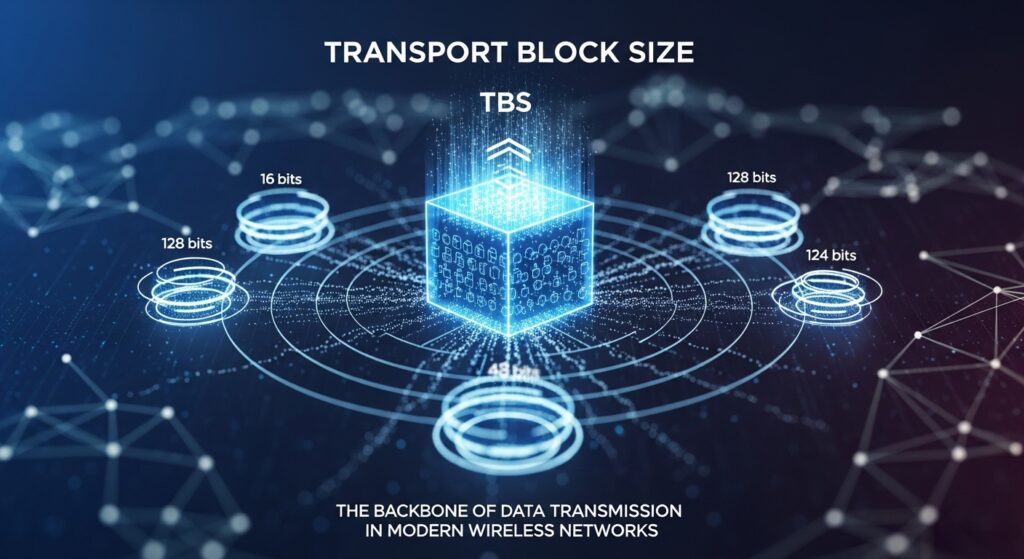
In today’s digital world, seamless connectivity is everything. Behind every video call, data stream, or mobile download lies a complex system of data management that ensures efficient and reliable communication. One of the most critical technical elements in this system is the Transport Block Size (TBS).
The Transport Block Size determines how much data can be transmitted in a single scheduling interval between a transmitter and receiver — a fundamental parameter in LTE (4G) and 5G NR (New Radio) networks. Understanding this concept is essential for network engineers, telecom professionals, and technology enthusiasts who want to grasp how mobile networks handle high-speed data.
What Is Transport Block Size?
The Transport Block Size (TBS) is the size, in bits, of the data block transmitted over a physical layer during one Transmission Time Interval (TTI).
In simpler terms, it’s the maximum amount of data that a mobile device (User Equipment – UE) can send or receive from the base station in one time slot.
The concept of TBS is part of the Medium Access Control (MAC) layer of the OSI model in wireless communication systems. It represents the payload that gets encoded and transmitted after various layers of data processing, including error correction, modulation, and coding.
Thus, TBS directly impacts data throughput, network efficiency, and latency.
Why Transport Block Size Matters
The Transport Block Size may sound like a small detail in the grand architecture of wireless communication — but it plays a pivotal role in determining network performance.
Here’s why TBS matters:
-
Optimized Data Throughput:
A well-calculated TBS ensures that the data rate matches the available channel capacity, avoiding underutilization or overload of resources. -
Efficient Spectrum Use:
The correct TBS allows the network to use its frequency spectrum efficiently, maximizing bandwidth without causing interference. -
Error Management:
Choosing the right TBS size balances error correction and redundancy, maintaining high reliability in data delivery. -
Latency Reduction:
Smaller TBS can lead to lower latency but may reduce throughput. The balance between the two defines the network’s responsiveness.
In essence, Transport Block Size is a crucial optimization tool that determines how effectively wireless networks deliver real-time data services.
How Transport Block Size Works
The Transport Block Size is determined dynamically based on several factors.
During transmission, the Base Station (gNB in 5G or eNB in LTE) schedules data for each user. It selects the Modulation and Coding Scheme (MCS), number of Resource Blocks (RBs), and channel quality indicator (CQI) to compute the TBS.
Here’s the process simplified:
-
Channel Estimation:
The UE reports the current channel conditions using a CQI value. -
Scheduling Decision:
The base station assigns a certain number of Physical Resource Blocks (PRBs) and selects a suitable MCS index based on the CQI. -
TBS Determination:
Using these parameters, the Transport Block Size is determined through standardized lookup tables defined by 3GPP (Third Generation Partnership Project) specifications (e.g., 3GPP TS 38.214 for 5G NR).
This ensures that each device receives an optimal TBS according to network conditions and link quality.
The Relationship Between MCS, PRBs, and TBS
The Transport Block Size is closely tied to two parameters:
-
MCS (Modulation and Coding Scheme)
-
PRBs (Physical Resource Blocks)
The MCS determines how many bits can be transmitted per symbol (depending on modulation type — QPSK, 16QAM, 64QAM, or 256QAM). The PRBs represent the frequency resources allocated for transmission.
Mathematically, a higher MCS and more PRBs mean a larger TBS — resulting in higher data throughput.
For example:
-
In poor signal conditions, the network uses QPSK modulation (lower MCS) → smaller TBS.
-
In excellent signal conditions, it may use 256QAM modulation (higher MCS) → larger TBS and faster speeds.
This adaptive mechanism ensures efficient use of resources under varying conditions.
TBS in LTE vs. TBS in 5G NR
Although the Transport Block Size concept is shared between LTE and 5G NR, the way it is calculated and used differs slightly due to the improved capabilities of 5G.
1. Transport Block Size in LTE
In LTE, TBS is determined from pre-defined lookup tables (as per 3GPP TS 36.213). The TBS depends mainly on the number of PRBs and the MCS index.
LTE supports a maximum TBS of up to 75,376 bits per TTI (for a 1 ms subframe).
The formula used involves:
-
Number of Resource Blocks (NPRB)
-
Modulation and Coding Scheme (MCS)
-
Code rate and symbol allocation
2. Transport Block Size in 5G NR
In 5G, TBS computation is more flexible and scalable. The standard (3GPP TS 38.214) introduces advanced parameters like layer multiplexing, slot configuration, and frequency numerology.
The maximum TBS in 5G can reach several megabits per slot, depending on bandwidth and carrier aggregation.
This flexibility allows 5G networks to support enhanced Mobile Broadband (eMBB) and Ultra-Reliable Low-Latency Communications (URLLC) simultaneously.
Factors Affecting Transport Block Size
Several parameters influence how the Transport Block Size is calculated dynamically:
-
Channel Quality (CQI):
Better signal strength allows for higher-order modulation and larger TBS. -
Bandwidth Allocation:
The more PRBs assigned to a user, the larger the TBS. -
Modulation Type:
QPSK, 16QAM, 64QAM, or 256QAM each defines different data rates. -
Coding Rate:
Determines the proportion of information bits versus error correction bits. -
MIMO Layers:
In multi-antenna systems, multiple transport blocks may be transmitted simultaneously, effectively multiplying throughput. -
HARQ Retransmissions:
Hybrid Automatic Repeat Request (HARQ) can adjust TBS during retransmissions for better reliability.
Each of these variables ensures that the Transport Size is optimized for the current network scenario.
The TBS Calculation Formula (Simplified)
While actual TBS computation involves several steps and lookup tables, a simplified version of the formula used in 5G NR is:
TBS=8×floor(R×Qm×NPRB×NRE−Oh8)TBS = 8 \times \text{floor}\left(\frac{R \times Q_m \times N_{PRB} \times N_{RE} – O_h}{8}\right)
Where:
-
R = Coding rate (fractional)
-
Qm = Modulation order (bits per symbol)
-
NPRB = Number of Physical Resource Blocks
-
NRE = Number of Resource Elements per PRB
-
Oh = Overhead (control data, reference signals, etc.)
This formula illustrates that Transport Block Size depends on modulation efficiency, allocated bandwidth, and coding rate.
Transport Block Size and Throughput
Throughput — the amount of data successfully delivered over a communication channel — is directly proportional to the Transport Block Size.
A larger TBS typically leads to higher throughput, assuming good channel conditions. However, it also increases the risk of data loss or retransmission if the channel quality degrades.
Therefore, adaptive algorithms dynamically adjust TBS in real time to maintain the balance between speed and reliability.
In 5G, this adaptive modulation and coding (AMC) mechanism allows networks to achieve data rates exceeding 10 Gbps under optimal conditions.
Transport Block Segmentation
When the data size exceeds the maximum supported Transport Size, it must be segmented into smaller units before transmission.
This process, known as Transport Block Segmentation, ensures that the network can transmit large packets efficiently without exceeding TBS limits.
Each segment undergoes independent channel coding and retransmission, improving error correction and minimizing packet loss.
Segmentation is especially crucial in 5G systems where massive data volumes — from streaming, IoT, or machine-type communication — are transmitted continuously.
Real-World Application of Transport Block Size
In practical terms, Transport Block optimization directly impacts user experience.
-
In streaming: Larger TBS allows smoother playback by enabling high data throughput.
-
In gaming: Adaptive TBS ensures low latency and responsive connections.
-
In IoT: Small, efficient TBS configurations optimize energy use for low-power devices.
-
In smart cities: Balanced TBS supports reliable communication between millions of connected sensors and systems.
In short, without efficient management of Transport Size, modern wireless communication would struggle to meet today’s speed, reliability, and capacity demands.
Challenges in Managing Transport Block Size
Despite its importance, calculating and optimizing TBS poses challenges:
-
Dynamic Environment:
Wireless channels constantly fluctuate due to movement, interference, and obstacles. -
Trade-Off Dilemmas:
Balancing throughput, latency, and reliability requires adaptive decision-making. -
Complex Computation:
Real-time calculation involves multiple layers of parameters and lookup tables, increasing processing complexity. -
Energy Consumption:
Larger TBS with high modulation can increase device power consumption, affecting battery life.
These challenges drive continuous innovation in algorithms and network optimization techniques.
The Future of Transport Block Size in 6G
As we move toward 6G networks, the concept of Transport Block Size will evolve further.
Future systems will likely feature:
-
AI-driven TBS optimization, predicting ideal block sizes based on user behavior and network conditions.
-
Dynamic multi-layer TBS, allowing different service types (e.g., AR/VR, IoT) to coexist efficiently.
-
Quantum-resistant coding schemes, enhancing reliability in next-gen communication.
In essence, Transport Block Size will remain at the core of how data flows through future wireless networks — smarter, faster, and more adaptable than ever.
Conclusion: The Heart of Wireless Efficiency
The Transport Block Size might seem like a technical detail, but it is one of the most vital parameters in wireless communication. It determines how efficiently data is packaged, transmitted, and received — directly influencing performance, reliability, and user experience.
From LTE to 5G and beyond, mastering TBS is key to unlocking the full potential of high-speed networks.
As telecom technology continues to advance, Transport Block Size will remain a cornerstone of data transmission — quietly powering the fast, connected world we rely on every day.