The public restroom is one of the most universal yet overlooked spaces in modern life — a place that blends privacy and exposure, function and reflection. While often dismissed as purely utilitarian, it mirrors the cultural values, expectations, and unspoken rules of the society that built it.
SQRMenRestroom, a bold and visionary brand and art project, seeks to challenge those assumptions. Emerging from the same conceptual lineage as SQR Women’s Restroom, this project reimagines the men’s restroom not just as a physical location, but as a symbolic landscape for exploring masculinity, vulnerability, and identity in the modern age.
By merging art, architecture, and philosophy, SQR Men’s Restroom invites us to question what it means to “be a man” in an era when definitions of strength, privacy, and emotion are being rewritten.
The Origin of SQR Men’s Restroom
The SQR collective, a multidisciplinary group of designers, artists, and thinkers, first gained attention with their groundbreaking installation SQR Women’s Restroom — a creative statement about space, identity, and inclusivity. Following its impact, the team turned their attention to the other side of the mirror: the men’s restroom.
The founders asked:
“If women’s spaces are being reimagined for empowerment and safety, how can we redesign men’s spaces for empathy and openness?”
The SQR Men’s Restroom project was born in 2020 as both an art installation and a conversation starter. The team sought to explore the architecture of masculinity — the walls, fixtures, and silences that shape how men express themselves.
Like its predecessor, the project uses the square (SQR) as a core symbol — representing structure, equality, and the box that many men are culturally conditioned to live within. The goal: to open that box.
The Meaning Behind the Name
The name SQR Men’s Restroom carries multiple layers of meaning:
-
SQR (Square): The square represents structure and symmetry — the stability often associated with traditional masculinity. Yet, in the SQR project, it also symbolizes constraint and the boundaries that define gender expectations.
-
Men’s Restroom: A literal reference to space, but also a metaphor for rest — a place where men can step away from societal performance and confront their inner selves.
Together, the phrase becomes a paradox: a structured space for unstructured emotions. It challenges the rigid systems that have long dictated how men are supposed to feel, behave, and exist.
The Art of Redefining Space
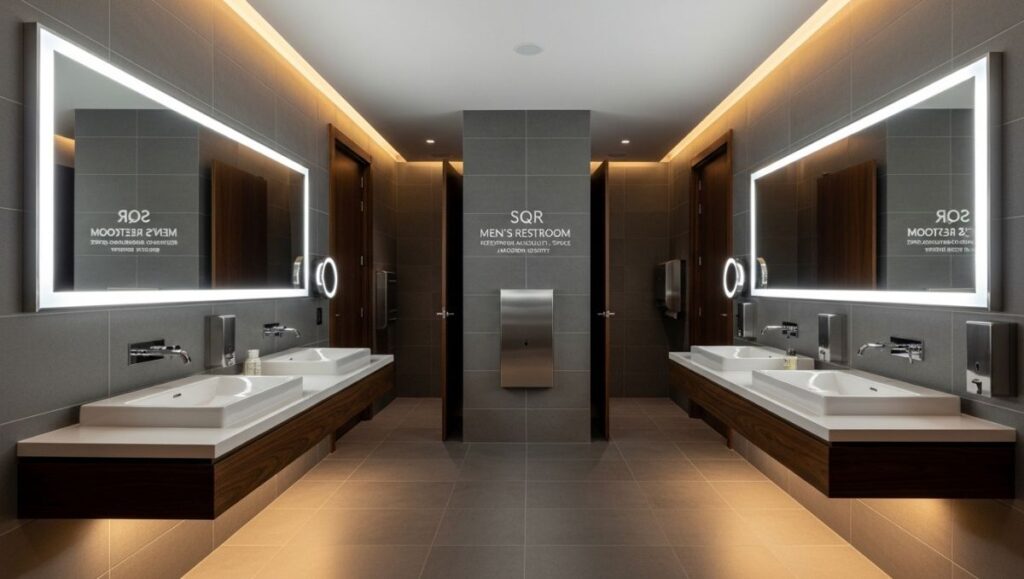
The SQRMenRestroom project transforms the architecture of a public restroom into an interactive installation and philosophical experience. Each element — from the tiles to the mirrors — is infused with metaphorical significance.
1. Mirrors as Truth
The mirrors, often the most personal element of any restroom, are central to SQR’s message. Instead of reflecting simple physical appearances, they project words, images, and stories collected from men across different cultures. Phrases like “It’s okay to not be okay” or “You don’t need to be unbreakable” appear briefly, then fade — leaving visitors with moments of quiet introspection.
2. The Soundscape
The ambient sound design replaces the expected echo of silence with layered recordings of conversations, laughter, and confessions — anonymous yet intimate. It reminds visitors that behind every stoic façade lies shared humanity.
3. The Color Palette
The design aesthetic blends industrial minimalism with warmth: muted grays, copper accents, and soft lighting. The aim is to dismantle the cold sterility typically associated with male spaces and replace it with atmosphere and vulnerability.
Through these design choices, SQR Men’s Restroom becomes a sensory dialogue about modern masculinity as both form and feeling.
Masculinity in the Mirror
For decades, public men’s restrooms have symbolized quiet detachment — a place where silence is customary and eye contact avoided. SQR flips this cultural script, asking: What if these spaces encouraged conversation, empathy, and reflection instead?
The project positions the men’s restroom as a metaphor for the unspoken realities of male identity. It examines how men are conditioned to maintain composure, suppress emotion, and equate strength with silence.
By reimagining this environment, SQR calls for a new masculinity — one defined not by dominance or suppression, but by openness, equality, and emotional literacy.
In interviews, the founders have described the project as “a deconstruction of the locker room mentality.” They aim to transform spaces traditionally coded as masculine into arenas of honesty rather than competition.
The Cultural Significance of the Restroom
SQRMenRestroom is among the few spaces where public and private life intersect. They are simultaneously intimate and shared — a paradox that mirrors the modern male experience.
SQR Men’s Restroom uses this paradox to explore cultural contradictions: men are encouraged to appear strong in public, yet often experience fragility in private. The project’s installations confront this tension directly.
In one exhibit, stall doors are engraved with questions such as:
-
What do you hide behind confidence?
-
When was the last time you cried in private?
-
Who are you when no one’s watching?
These questions transform the restroom into a confessional — not of shame, but of self-acceptance.
By doing so, SQR positions itself at the intersection of design, psychology, and social awareness, redefining what it means to occupy space as a man.
From Art to Brand: The SQR Evolution
Like its sister project, SQR Men’s Restroom evolved into a cultural brand that merges aesthetics with activism.
1. Design Objects
SQR produces limited-edition objects — mirrors, apparel, and prints — that carry the same minimalist design philosophy as the installations. Each item acts as a conversation starter about vulnerability and equality.
2. Digital Storytelling
The brand’s digital presence functions as a virtual extension of the installation. Through short films, photography, and augmented-reality experiences, viewers can explore themes of identity and emotion in interactive form.
3. Collaborative Exhibitions
SQR has collaborated with mental health organizations, art museums, and creative collectives to expand its message beyond design into social impact. These partnerships often feature workshops on emotional intelligence, fatherhood, and communication — translating artistic philosophy into real-world dialogue.
In this way, SQR Men’s Restroom is more than an installation — it’s an evolving ecosystem of design, discussion, and digital culture.
Reimagining Modern Masculinity
At its heart, SQRMenRestroom is an invitation to redefine masculinity for a new era. Its philosophy revolves around four core principles:
-
Openness Over Strength – Vulnerability is not weakness; it is courage in its purest form.
-
Design as Reflection – The spaces we create shape how we behave within them. Better spaces mean better selves.
-
Equality of Space – True equality requires redesigning both women’s and men’s environments with empathy and intention.
-
Collective Healing – By normalizing emotional dialogue, communities can redefine connection beyond stereotypes.
Through these principles, SQR advocates a shift from rigid gender roles to fluid human experience — one where design, emotion, and identity coexist.
The Symbolism of SQR: The Square Revisited
The square, at the heart of SQR’s identity, has always represented structure and equality. But within the Men’s Restroom project, it takes on new life as a symbol of transformation.
-
The four sides represent mind, body, emotion, and environment — all interconnected dimensions of masculinity.
-
The corners signify the cultural boundaries that confine men, now being redefined by new generations.
-
The center of the square represents reflection — the moment where structure meets stillness, and identity is reexamined.
Thus, the square is not a cage but a canvas — a reminder that structure can coexist with sensitivity, and that masculinity, like art, is meant to evolve.
Modern Relevance and Impact
SQRMenRestroom resonates deeply with today’s cultural moment. Conversations about men’s mental health, toxic masculinity, and emotional literacy have gained global traction, yet they often lack artistic representation.
By transforming these conversations into spatial and visual experiences, SQR bridges the gap between awareness and empathy.
Its installations have been featured in urban art festivals, design expos, and social campaigns that advocate for gender balance. Audiences describe the project as both visually minimalist and emotionally expansive — proof that even the simplest concepts can spark profound dialogue.
The Future of SQRMenRestroom
As the brand continues to grow, the SQR collective envisions expanding into architectural collaborations, immersive experiences, and education.
Upcoming initiatives include:
-
SQR Public Spaces: Redesigning communal environments — from restrooms to lounges — using inclusive design principles.
-
SQR Dialogues: A digital platform for men to anonymously share stories, reflections, and art about vulnerability and identity.
-
SQR x Therapy: Collaborations with mental health professionals to use design as a therapeutic tool.
In these future endeavors, SQR continues to champion the idea that design is not just visual — it’s emotional.
Conclusion
The SQRMenRestroom project stands as a powerful redefinition of masculinity and space. It takes one of the most ordinary places in modern life and transforms it into an arena for introspection, empathy, and art.
Through minimalism, symbolism, and social purpose, SQR reminds us that the spaces we inhabit reflect who we are — and who we wish to become.
In its quiet, geometric way, SQRMenRestroom declares a new manifesto for modern manhood:
Strength is found in softness.
Privacy is a pathway to truth.
And every man deserves a mirror that reflects not perfection, but possibility.