Introduction
Choosing the right orthodontic treatment for your child is an important decision that impacts not just their oral health but also their confidence and daily comfort. With modern solutions like Invisalign aligning alongside time-tested traditional metal braces, parents now have more options than ever. Understanding the differences between these treatments can help you make a well-informed choice tailored to your child’s unique needs. To review your options with a local professional, visit dentistsofhinsdalelake.com for more information.
Both Invisalign and traditional braces work by gradually shifting teeth into their correct positions, but each system uses different techniques and materials. While the principles behind them are similar, factors such as appearance, cost, treatment length, and comfort vary. How do you decide which one is best for your child?
Understanding Invisalign for Kids
Invisalign utilizes a series of custom-made, clear plastic aligners that fit snugly over the teeth. These aligners are switched out every one to two weeks, allowing for controlled tooth movement over time. One of the main advantages of Invisalign is its discreet nature, making it attractive to children and teenagers who may be self-conscious about their appearance during treatment. The aligners are removable, letting your child maintain their normal eating habits and oral hygiene routine with minimal disruption.
However, Invisalign for kids requires commitment. The aligners must be worn for 20 to 22 hours per day to be effective. If your child tends to forget or lose things easily, or if you are concerned about compliance, this may be something to consider.
Traditional Metal Braces: The Time-Tested Solution
Traditional braces use metal brackets and wires to systematically realign teeth. Unlike Invisalign, these braces are fixed to the teeth and adjusted by the orthodontist at regular intervals. The fixed nature of braces means your child cannot lose or forget to wear them, making them especially effective for younger kids or those who might lack the discipline needed for removable aligners.
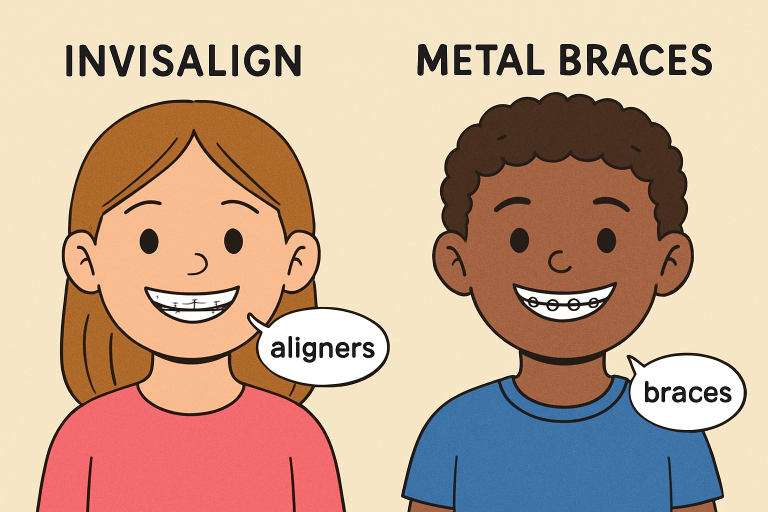
Because they can exert more precise and consistent force on the teeth, traditional braces are often recommended for complex cases, including significant crowding, major bite issues, or severe spacing. Modern braces are also less bulky and more comfortable than in the past, and colorful bands give kids the opportunity for self-expression.
Comparing Comfort and Appearance
Invisalign’s clear, smooth plastic trays generally cause less discomfort and irritation compared to metal wires and brackets. With no wires poking or brackets rubbing against the soft tissues in the mouth, children often find Invisalign to be more comfortable, especially early in treatment.
Aesthetically, Invisalign is almost invisible, which is ideal for self-conscious kids and teens. On the other hand, metal braces are visible but come with the fun option of colored bands and have become somewhat of a rite of passage. At the end of the day, the most comfortable or appealing solution is often the one your child will consistently use as instructed.
Daily Life and Maintenance Considerations
Daily routines differ significantly between the two treatments. Invisalign is removed for eating and brushing, so there are no dietary restrictions and oral hygiene is generally easier. However, the aligners must be kept clean and cannot be misplaced.
Traditional braces do not need to be removed, but special care is necessary for cleaning around brackets and wires, and certain foods must be avoided to prevent breakage. Your child may also need more frequent orthodontic appointments for adjustments, compared to the smoother schedule often possible with Invisalign.
Cost and Treatment Duration
Costs for Invisalign and traditional braces can be similar, but the total price depends on the length and complexity of the treatment needed. In general, extremely complicated cases may be addressed more efficiently with traditional braces, possibly reducing total treatment time. Invisalign may be most cost-effective for milder misalignments.
Many dental insurance plans now provide some coverage for both options. Financial considerations should be balanced with your child’s needs and the anticipated effectiveness of each treatment modality.
Which Is Best For Your Child?
There is no one-size-fits-all answer to the Invisalign versus traditional braces debate. If your child has mild or moderate alignment issues, is self-motivated, and values a discreet treatment plan, Invisalign could be an excellent fit. For more complex dental challenges, or if you are seeking a tried-and-true approach that does not rely on patient compliance, traditional braces may be the better solution.
Ultimately, the best way to determine what works for your child is to schedule an orthodontic consultation where a specialist can assess their unique needs, explain expected outcomes for each treatment, and answer your questions.
Conclusion
Both Invisalign and traditional braces are powerful tools for creating straight, healthy smiles. The right choice comes down to a mix of medical, lifestyle, and personal factors unique to your child and family. Consulting with an experienced orthodontist will put you on the right path toward a confident decision and a beautiful result for your child’s smile.