
In today’s fast-paced digital landscape, managing dispersed network infrastructures has become more complex, requiring organizations to rethink their approach to connectivity and control. Enterprises that span continents face mounting challenges, with the need to address not only global connectivity and robust security but also swift adaptability to emerging needs—all while simultaneously cutting down on operational costs and simplifying what were once complicated networks. SD-WAN managed services have emerged as an innovative and transformative solution, providing a more efficient way to streamline network management. They empower IT teams to achieve reliable, scalable, and secure connectivity across every location, from large headquarters to remote branches and mobile workers. This makes it possible for organizations to stay responsive in a rapidly changing digital environment.
By adopting SD-WAN managed services, IT professionals gain unprecedented control and flexibility when orchestrating wide area networks regardless of how organizational requirements change over time. Instead of struggling with hardware-centric, inflexible networks, companies can now leverage software-based intelligence to automate critical network functions, ensure security, and optimize performance.
Centralized Management
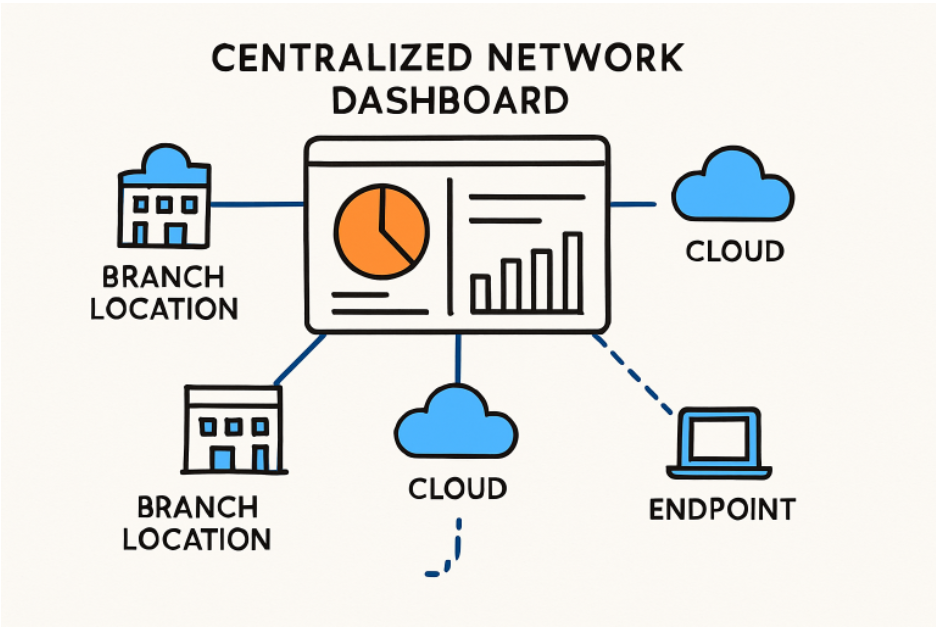
One of the most celebrated breakthroughs that SD-WAN brings to modern networking is its centralized management functionality. Traditionally, managing a large distributed network—across multiple branch offices, data centers, and cloud platforms—required a hybrid of tools and manual configurations, often leading to inconsistencies, higher risk of error, and increased overhead. With SD-WAN, IT teams can administer, monitor, and configure all network settings from a unified dashboard, regardless of how dispersed the locations are. Through this centralized approach, network administrators gain the ability to deploy new policies, push updates, and oversee network health on a global scale, all in real time. This streamlined process significantly reduces the chance for misconfigurations and human error during rollouts and ensures that network standards and security protocols are uniformly applied company-wide.
Automated Traffic Routing
SD-WAN solutions are engineered to dramatically improve network performance through automated traffic routing and intelligent path selection. Rather than relying on static routes or manual configuration, SD-WAN employs real-time analytics to actively monitor network conditions such as latency, jitter, congestion, and overall throughput across all possible paths. When abnormal network behavior or degradation is detected, SD-WAN instantly reroutes traffic to the best available path—a broadband circuit, MPLS line, or cellular connection—without user intervention. This continuous optimization is invaluable for organizations running latency-sensitive applications like VoIP, video conferencing, or mission-critical SaaS solutions, ensuring uninterrupted performance even during peak usage or outages.
Enhanced Security Measures
In an era where cyber threats are growing more advanced and distributed, security must be integrated into every network layer. SD-WAN addresses this imperative by weaving comprehensive security features directly into the network fabric. By applying end-to-end encryption to data in motion and segmenting network traffic based on user, application, or site type, SD-WAN mitigates risks posed by third-party attacks and internal vulnerabilities. Security policies can be managed centrally and updated instantly across all endpoints, ensuring consistent enforcement of company protocols and regulatory standards. Furthermore, SD-WAN platforms offer robust threat detection tools and prevention mechanisms—such as firewalls, intrusion prevention systems, and secure web gateways—integrated within the same management console. With real-time monitoring and automated responses to potential threats, organizations reduce the attack surface and shield sensitive corporate data from external and insider breaches.
Cost Efficiency
Cost management remains a primary factor driving enterprises toward SD-WAN adoption. Traditional MPLS-based architectures are expensive because they require dedicated circuits and extensive hardware investments to ensure reliability and security. SD-WAN, in contrast, enables organizations to leverage a blend of readily available broadband links with existing MPLS lines or LTE/5G networks, significantly driving down both capital expenditures (CapEx) and operating expenses (OpEx). Through dynamic bandwidth allocation and advanced traffic prioritization, SD-WAN ensures critical applications are routed through the most reliable channels. In contrast, less sensitive traffic can traverse less costly paths. Not only does this reduce dependency on premium-priced links, but it also makes the overall telecom budget much more predictable. Reduced downtime and more effective use of network resources amplify these savings, enabling companies to allocate funds toward innovation, digital initiatives, or business expansion, rather than simply maintaining connectivity.
Scalability and Flexibility
Business environments are never static, so network infrastructure must be poised for rapid scaling and adaptation. SD-WAN’s flexibility is its hallmark; whether an organization needs to open a new branch office, quickly support a remote workforce, or add bandwidth to accommodate business growth, SD-WAN can affordably and efficiently meet those needs. New endpoints can be set up with little more than a pre-configured device and a management portal login, drastically reducing the time and expertise needed for site activation. Likewise, businesses entering new markets, embarking on acquisitions, or migrating workloads to the cloud can expand their footprint seamlessly, without the logistics, contracts, or up-front investment previously required. This future-proof approach ensures that IT can quickly pivot to support evolving business models, new customer demands, and shifting technology landscapes—while still keeping everything under centralized, automated control.
Improved Network Visibility
The complexities of managing a distributed network are vastly reduced when administrators have access to actionable, real-time insights. SD-WAN platforms provide a single-pane view of the entire WAN—encompassing on-premises infrastructure, cloud resources, and remote gateways—along with easy-to-understand dashboards for monitoring application performance and network health. With granular analytics, IT teams can detect and respond to anomalies, bottlenecks, or security incidents long before they impact end users. These tools enable more accurate capacity planning, proactive troubleshooting, and evidence-based decision-making, leading to higher productivity and lower mean time to resolution for network issues. Administrators can also generate detailed reports for compliance, executive review, or internal optimization efforts.
Support for Multi-Cloud Environments
Digital transformation increasingly involves the distributed use of cloud services, with many organizations adopting a hybrid or multi-cloud strategy to maximize business agility and resilience. SD-WAN is purpose-built for this reality, integrating secure, high-performance connectivity across public, private, and even SaaS platforms. IT teams can provision new cloud connections on demand, ensuring that users—from any location—receive seamless, reliable access to business-critical applications. This enhances overall IT agility and business continuity, accelerates development cycles, enables digital initiatives, and minimizes the learning curve or delay when onboarding new services.
Final Thoughts
Embracing SD-WAN managed services is a game-changer for enterprises seeking to simplify complex network environments while boosting agility, security, and cost efficiency. With centralized management, intelligent automation, integrated security, and cloud-ready architecture, SD-WAN empowers organizations to confront today’s IT demands and adapt to tomorrow’s challenges. As digital transformation becomes a business imperative, investing in SD-WAN enhances immediate operational effectiveness and future-proofs your network for continuous adaptation and long-term success in a connected world.