
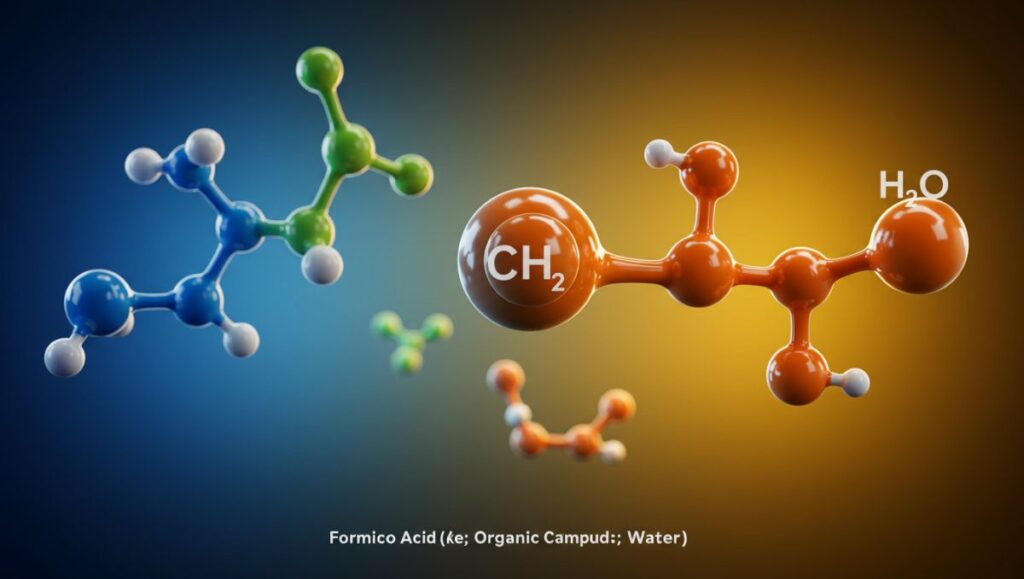
When diving into the fascinating world of organic chemistry, certain compounds stand out due to their intriguing properties and versatile applications. Among these, HCOOH CH2 H2O capture attention for their unique structure and significance in various chemical reactions. Whether you’re a student exploring the fundamentals or a professional looking to deepen your understanding, this compound serves as an essential building block in many organic processes. Let’s unravel the science behind HCOOH CH2 H2O and discover why it holds such importance in both research and industry!
Properties and Structure of HCOOH CH2 H2O
HCOOH CH2 H2O is an intriguing compound in organic chemistry. It consists of formic acid (HCOOH) and methylene (CH2), combined with water (H2O). This combination brings together essential elements that contribute to its unique properties.
The molecular structure showcases a simple yet effective arrangement. The carboxylic group in formic acid provides acidity, while the methylene unit allows for various interactions. Together with water, this creates a versatile solution.
This compound demonstrates strong hydrogen bonding due to the presence of both hydroxyl and carbonyl groups. Such bonding significantly affects its boiling point and solubility characteristics.
Additionally, HCOOH CH2 H2O exhibits polar behavior, making it useful in different chemical environments. Its ability to act as both an acid and a base further emphasizes its significance in reactions across organic chemistry settings.
Applications in Organic Chemistry
HCOOH CH2 H2O plays a significant role in various organic chemistry applications. This compound is vital for synthesizing numerous organic molecules, including esters and alcohols.
In addition, it serves as a building block in the preparation of pharmaceuticals. The versatility of HCOOH CH2 H2O allows chemists to explore innovative pathways in drug development.
Moreover, this compound acts as a solvent in chemical reactions, enhancing reaction rates and yields. Its unique properties facilitate essential processes like esterification and alkylation.
Researchers also utilize HCOOH CH2 H2O for environmental studies. It helps analyze pollutants and assess biochemical interactions within ecosystems.
The study of this compound continues to yield insights into new methodologies that can revolutionize synthetic strategies within organic chemistry laboratories around the globe.
Reactions and Mechanisms involving HCOOH CH2 H2O
HCOOH CH2 H2O, a fascinating trio in organic chemistry, plays an essential role in various reactions. Formic acid (HCOOH), methylene (CH2), and water (H2O) interact in unique ways that contribute to their reactivity.
One notable reaction involves the esterification of formic acid with alcohols. This process leads to the formation of esters and is vital for synthesizing many organic compounds. The addition of water can shift the equilibrium, influencing product yields.
Additionally, these components participate in oxidation-reduction reactions. For example, formic acid can be oxidized to carbon dioxide while reducing metal ions—a key step in catalysis.
The presence of H2O often acts as both a solvent and a reactant. It facilitates hydrolysis processes where substrates break down into simpler molecules.
Understanding these mechanisms enhances our grasp of complex chemical pathways and opens doors for innovative applications across multiple scientific fields.
Importance in the Pharmaceutical Industry
HCOOH CH2 H2O plays a significant role in the pharmaceutical industry. Its unique properties make it essential for various applications, including drug formulation and synthesis.
The small molecular structure allows for easy integration into complex compounds, enhancing solubility and bioavailability. This is crucial when developing new medications that require optimal absorption in the body.
Moreover, HCOOH, H2O is often used as a reagent in organic reactions. It helps facilitate numerous transformations essential for synthesizing active pharmaceutical ingredients (APIs).
Research continues to explore its potential in creating innovative therapies. As scientists uncover more about this compound’s capabilities, its application may expand further within pharmacology.
Additionally, regulatory agencies recognize its importance due to safety considerations during drug development processes. Utilizing such components can lead to safer and more effective therapeutic options on the market.
Potential Future Developments
Research into HCOOH CH2, H2O is advancing rapidly. Scientists are exploring its potential in sustainable energy solutions. This compound may play a crucial role in developing biofuels.
Innovations in catalysis could enhance the efficiency of reactions involving these components. Improved methods will lower costs and reduce waste, making processes greener.
Moreover, advancements in nanotechnology might enable more precise applications. This can lead to breakthroughs in material sciences or even electronics.
As researchers investigate new synthesis routes, they may uncover additional properties that were previously unknown. These discoveries can unlock unexplored applications across various industries.
Collaboration between academia and industry will be essential for translating laboratory findings into practical uses. The future looks promising as we continue to understand the significance of HCOOH CH2 more deeply, leading us toward novel developments and technologies that benefit society at large.
Conclusion
The study of HCOOH CH2 H2O reveals its significant role in organic chemistry and beyond. This compound showcases unique properties that make it essential for various applications, from industrial processes to pharmaceutical innovations.
Its versatility is evident in the reactions it participates in, effectively driving forward many important chemical transformations. As research continues to expand our understanding of this molecule, we may uncover even more potential uses that could reshape industries.
With a growing emphasis on sustainable practices and innovative solutions, the future developments involving HCOOH CH2 H2O look promising. The ongoing exploration into its capabilities opens doors to advancements that can benefit both science and society as a whole.
Understanding these key components not only enriches our knowledge but also highlights the interconnectedness of chemistry with real-world challenges. Embracing such discoveries paves the way for groundbreaking progress across multiple fields.