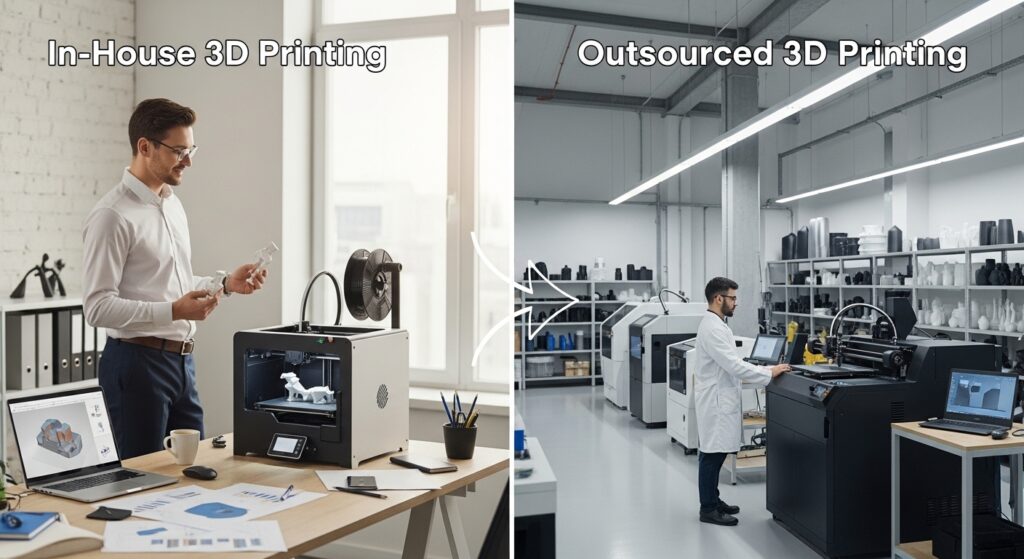
Have you wondered how businesses decide whether to do 3D printing in-house or outsource? The decision can significantly impact the success of your project, especially in Australia’s rapidly evolving market. In-house printing gives you control by owning the equipment, while outsourcing sends designs to specialists.
It can feel quite overwhelming when trying to balance costs, quality, and timelines. That’s why we will be breaking this down in steps. Let’s start by looking at what each option entails, so you can see how they might apply to your situation!
What Does In-House 3D Printing Involve?
Opting for in-house 3D printing means bringing the entire production process under your roof. It transforms your workspace into a mini manufacturing hub where creativity meets instant execution. This setup typically requires an investment in quality 3D printers, compatible materials like resins or filaments, modelling software, and the right digital infrastructure to manage design files. You’ll also need to train your team in printer operation, design optimisation, and maintenance routines to ensure consistent output.
In-house printing is especially beneficial for companies that produce prototypes regularly or need rapid design adjustments during development. For example, product designers and engineers can test ideas immediately, tweak measurements, and print the next iteration within hours instead of waiting for days. This speed and flexibility can significantly shorten product development cycles and give you a competitive edge.
The biggest advantage of this setup is control; you decide what gets printed, when, and how. There’s no waiting for external partners or worrying about data confidentiality. However, this control comes with responsibility. You must commit to ongoing maintenance, software updates, and periodic calibration of the machines to keep everything running smoothly. Additionally, as technology evolves, you’ll need to upgrade equipment to maintain quality and efficiency.
What Do Outsourced 3D Printing Services Offer?
Choosing to outsource 3D printing is about leveraging external expertise and advanced technology without the upfront investment. You collaborate with professional printing service providers who already have industrial-grade machines, a wide range of materials, and experienced operators. All you need to do is upload your CAD files, specify the material and finish, and wait for your completed parts to arrive.
This option is perfect for businesses that print occasionally, are testing the technology, or require specialised materials and finishes that would be expensive to maintain in-house. Outsourced services can handle large volumes, intricate designs, and complex geometries that might be challenging for a smaller internal setup.
The convenience is undeniable; no need to worry about maintenance costs, staff training, or downtime. It’s also a scalable solution; you can increase or decrease production as needed without any infrastructure changes. However, outsourcing does mean relinquishing some control over timelines and quality. You’ll depend on the provider’s availability and production schedule, which can occasionally cause delays.
Still, for many companies, outsourcing strikes the perfect balance between cost-efficiency and professional-grade results, especially when precision, speed, and material diversity are priorities.
In-House vs Outsourced 3D Printing
| Aspect | In-House 3D Printing | Outsourced 3D Printing |
| Speed | Rapid turnaround, often within hours, enabling quick iterations and innovation. | Lead times can extend to days or weeks, depending on the provider’s schedule. |
| Cost | High upfront costs for printers, materials, and maintenance. Per-part cost decreases with high volumes over time. | Predictable per-job costs, budget-friendly for low-volume or one-off projects. No equipment investment needed. |
| Equipment | It requires purchasing and maintaining printers, which can become outdated. | Access to cutting-edge printers (e.g., metal or high-resolution) without ownership costs. |
| Expertise | It requires training staff, which can strain small teams and take time. | Built-in expertise from specialists who advise on designs, materials, and finishes. |
| Scalability | Challenging to scale; growing needs may require more machines, adding complexity. | Easy to scale by leveraging the provider’s resources; no additional investment needed. |
| Intellectual Property | High control reduces the risk of leaks as everything stays internal. | Slight risk when sharing files externally, though most providers have secure processes. |
| Maintenance | Ongoing maintenance and unexpected repairs can disrupt workflows. | No maintenance hassles; providers handle calibration, cleaning, and repairs. |
| Flexibility | Ideal for frequent prototyping and quick design tweaks. | Suited for sporadic projects or those requiring diverse technologies. |
| Risks | Equipment may sit idle during low demand, tying up capital. Risk of outdated technology. | Shipping costs and potential damage risks, especially for delicate parts. |
| Quality Control | Full control over quality, but reliant on in-house expertise. | Relies on the provider’s processes, with potential for communication errors leading to reprints. |
Key Factors to Consider in Your Decision
So, how do you choose? Start with your volume needs. High-frequency printing? In-house might save money long-term. Occasional use? Outsourcing keeps things simple.
- Budget plays a huge role. Calculate total ownership costs for in-house versus per-project fees for outsourcing. Don’t forget hidden expenses, such as electricity or waste disposal.
- Consider your timeline requirements. Urgent prototypes favour in-house speed, while complex jobs benefit from outsourced expertise.
- Think about your team’s skills. If you lack in-house know-how, outsourcing provides a safety net. But if you’re building capabilities, starting small with your own printer could empower your operations.
- Location matters too, particularly in Australia, where distances can affect shipping. If you’re in a major city, local services minimise delays.
If you’re seeking a reliable 3D Printing Architectural Model In Australia, consider us. Our team can guide you through the process, tailored to your specific project needs.
Hybrid Approaches
Some businesses blend the two, using in-house for quick prototypes and outsourcing for production runs or specialised materials. This hybrid model maximises efficiency, allowing you to leverage the strengths from each side. It requires careful planning, but it can reduce risks and optimise resources.
Implementing a Hybrid Strategy
To make it work, assess which tasks will remain internal and which will be outsourced. Clear guidelines ensure smooth transitions.
Making the Right Choice for Your Business
In the end, your choice depends on your particular situation. Weigh the pros and cons thoughtfully, trialling a small outsourced job to gauge fit.
Remember, there’s no one-size-fits-all approach; what works for a large manufacturer might not work for a small design firm. Be kind to yourself in this process; it’s about finding a sustainable path forward.
If you’re based in Australia and need expert help, a top-notch 3D printing service in Melbourne, such as CAD Deziners, could be the perfect partner to outsource to, for precision and professional-grade results.
Final Thoughts
Comparing in-house and outsourced 3D printing services reveals a landscape full of opportunities tailored to different business stages and needs. By understanding the trade-offs, you can select an approach that supports your goals, fosters innovation, and manages costs effectively. No matter if you go internal, external, or a mix, the key is aligning with what drives your success.