
Introduction
Patient privacy is a foundational principle in healthcare, critical for maintaining trust, dignity, and compliance with legal requirements. At every level of care, hospitals face the pressing challenge of safeguarding personal information while ensuring a comfortable, confidential environment. Today’s healthcare facilities are embracing advanced solutions that prioritize privacy without sacrificing operational efficiency or patient experience.
Leading these innovations is PRVC Systems, a recognized authority in healthcare privacy and safety solutions. PRVC Systems provides modern cubicle curtain systems designed to uphold patient dignity, support infection control, and seamlessly integrate with hospital infrastructure. Their website offers detailed information about their products and services, along with case studies demonstrating real-world applications. With extensive experience across hospitals, clinics, and surgical centers, PRVC Systems delivers solutions tailored to meet the unique privacy and safety needs of healthcare environments. Their services cover Texas and extend nationwide, ensuring compliance, comfort, and operational efficiency wherever healthcare is delivered.
Advancements in Cubicle Curtain Systems
Innovations in patient privacy begin at the bedside. New cubicle curtain systems are far superior to traditional designs, prioritizing coverage, flexibility, and hygiene. These modern systems feature antimicrobial fabrics to reduce infection risk and are engineered for easy removal and laundering, supporting a cleaner patient environment. Rounded or trackless designs reduce trip hazards and allow for full enclosure without the gaps that once compromised privacy.
One critical advancement is the integration of cubicle curtains with patient lift systems. As patient mobility solutions become an integral part of hospital care, curtains and tracks must be seamlessly compatible. Integrated designs prevent tangling or entrapment, ensuring that patient lifts can operate safely and efficiently. This combination of careful engineering and user-friendly design is essential for meeting the needs of today’s dynamic healthcare settings.
Smart Glass Technology
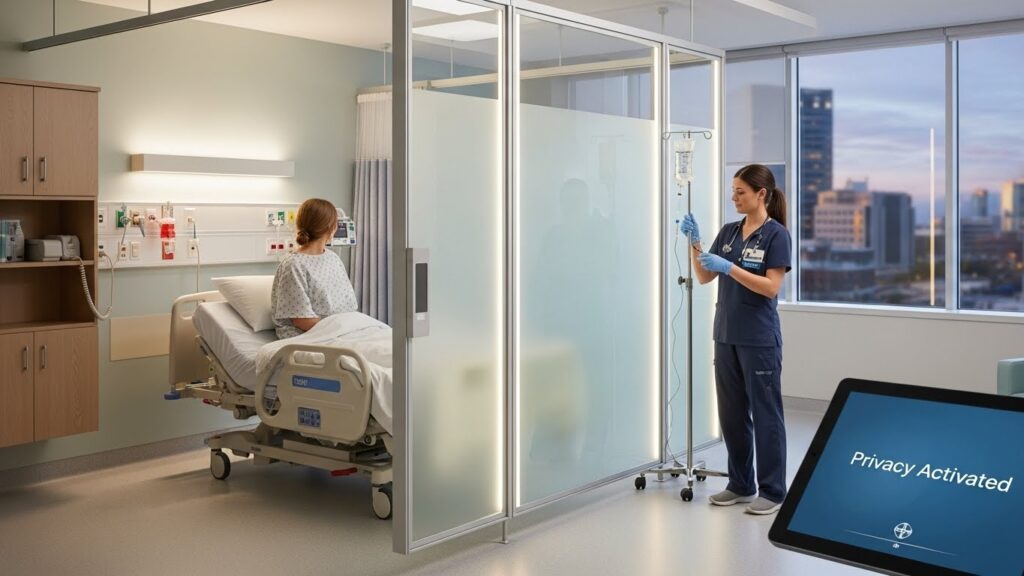
The adoption of switchable smart glass is transforming how hospitals approach privacy in patient rooms, consultation areas, and isolation spaces. This technology uses a special film that transitions from transparent to opaque with the flip of a switch, providing instant visual privacy as needed. The main benefit is flexibility; staff and patients can quickly adapt the level of visibility while maintaining an open, bright atmosphere whenever privacy is not required.
Beyond privacy, smart glass promotes healing. Maximizing access to natural light supports patient well-being, reduces stress, and can even speed recovery. Its sleek, integrated appearance also means fewer physical obstructions and easier cleaning, helping maintain the highest standards of infection control. The introduction of these innovative materials is making a noticeable impact on the aesthetic and functional design of modern hospitals.
Digital Privacy Measures
With the digitization of patient data, robust privacy safeguards are more essential than ever. Hospitals are implementing advanced patient identification systems that use biometric data—such as fingerprints or facial recognition—ensuring only authorized staff can access health records or restricted areas. These methods provide faster, more accurate authentication, reducing the risk of human error or identity breaches.
Blockchain technology is also being used to protect patient data integrity. By decentralizing records and creating immutable access logs, healthcare organizations can guarantee transparency and prevent unauthorized modifications. The result is stronger, faster, and more reliable verification processes that enhance privacy for patients and staff alike.
Integrated Emergency Response Systems
Hospitals are rapidly deploying Internet of Things (IoT) devices throughout their campuses. Sophisticated sensors detect emergencies—such as aggression, unauthorized entries, or falls—and automatically trigger responses including alerting security personnel, locking down sensitive areas, or even contacting law enforcement. This tightly coordinated approach ensures threats are identified and managed with minimal delay, protecting both patients and caregivers. The integration with local authorities further strengthens hospital preparedness, reducing response times and ensuring that incidents are handled efficiently. These advancements reflect a commitment to proactive safety as an essential component of privacy.
AI-Powered Video Surveillance
Artificial intelligence is revolutionizing hospital security by enabling real-time video analytics. AI-powered surveillance systems can monitor behavioral patterns, identifying unauthorized attempts to access restricted zones and recognizing signs of distress and aggression before they escalate. This level of automation significantly reduces the need for continuous live monitoring, allowing security staff to focus on responding only to genuine threats.
With automated alerts and advanced learning algorithms, these systems are improving patient privacy—not only by detecting breaches but by eliminating unnecessary human review of footage, thus limiting exposure of sensitive patient encounters.
Cloud-Based Access Control Systems
Cloud-based access control is providing hospitals with unprecedented flexibility and oversight. Centralized management enables administrators to issue, revoke, and monitor credentials across multiple facilities from a single dashboard, dramatically simplifying compliance and incident response. These systems are especially valuable for large hospital networks or those with remote clinics, ensuring that only credentialed personnel have access to sensitive zones.
Remote control capabilities allow hospital leadership to lock or unlock doors instantly, even from miles away. This not only strengthens core privacy but also enables nimble responses during emergencies or personnel changes, supporting a safer, more agile healthcare environment.
Conclusion
The privacy landscape in healthcare is rapidly evolving, driven by emerging technologies and changing standards of care. Hospitals are investing in advanced cubicle curtain systems, innovative glass privacy solutions, digital security measures, AI-powered surveillance, and cloud-based controls to provide safer, more dignified environments for patients and staff alike. These investments reflect a commitment to innovation and patient-centered care, underscoring how privacy and security are intertwined with quality outcomes and hospital reputation. As healthcare continues to transform, integrating these advanced solutions positions facilities to meet new challenges and deliver exceptional patient experiences—now and in the future.