
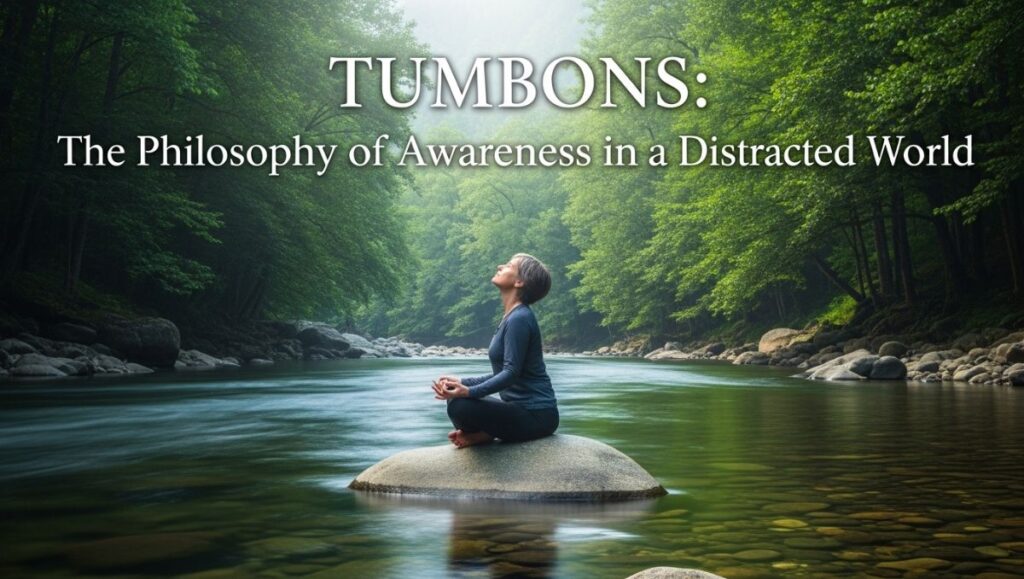
In a world filled with endless noise, speed, and constant digital stimulation, the concept of tumbons emerges as a profound philosophical invitation: to awaken awareness in every moment. Rooted in the idea that consciousness itself is both the path and the destination, tumbons invites individuals to reconnect with their senses, thoughts, and surroundings — not as passive observers, but as active participants in the unfolding of existence.
The Meaning of Tumbons
At its core, tumbons is more than a word — it is an attitude toward life. It represents a state of heightened awareness, where perception becomes intentional and experience becomes sacred. The philosophy teaches that awareness is not simply noticing what happens, but understanding how and why we experience reality the way we do.
In this sense, tumbons is a call to slow down and witness the subtle layers of being. It encourages one to look beyond the surface — to observe not just the event, but the inner response it triggers. It’s a practice of mindfulness that transcends meditation cushions and enters the rhythm of daily life.
The Origins and Essence of the Concept
Although tumbons is a contemporary term, its essence echoes through ancient wisdom traditions. From Buddhist mindfulness to Stoic reflection and even the phenomenology of Husserl and Merleau-Ponty, awareness has always been at the heart of human inquiry.
However, what makes tumbons distinct is its modern reinterpretation of awareness. It doesn’t ask us to renounce technology or withdraw from the world; instead, it invites us to engage consciously with it. To practice tumbons is to scroll, speak, listen, and act with full awareness of our intentions and their effects.
In this way, tumbons bridges the ancient and the modern, offering a practical philosophy for the digital age — one that harmonizes presence with progress.
Awareness as the Foundation of Existence
According to the philosophy of tumbons, awareness is not something we possess; it is what we are. Every thought, sensation, and emotion arises within the field of consciousness, and tumbons reminds us to return to this ground of being.
When we live without awareness, life becomes mechanical — a sequence of reactions, distractions, and habits. We lose contact with the depth of our own existence. But when we live with awareness, even simple actions like breathing, eating, or walking become profound.
Tumbons suggests that awareness is not an end goal, but a way of being. It is the silent observer behind every experience, the calm presence that remains unchanged amid change. To live tumbons is to cultivate this steady awareness — to become the witness and the participant at once.
The Principles of the Tumbons Philosophy
The tumbons approach can be summarized through a few guiding principles that shape its practice and worldview:
1. Presence Over Projection
The present moment is the only reality we truly inhabit. Tumbons emphasizes the importance of presence — not as a cliché, but as a discipline. Each moment is an invitation to observe, feel, and act from a place of clarity rather than distraction.
2. Observation Without Judgment
Awareness is neutral. When we observe without labeling, we perceive truth more clearly. Tumbons teaches that judgment clouds perception, while acceptance opens insight. This doesn’t mean passive resignation, but the ability to see what is, before deciding how to respond.
3. Connection Over Control
In the tumbons view, awareness reveals interconnection. We are not isolated entities, but part of a vast web of consciousness. Recognizing this interdependence shifts us from control to compassion — from ego-centered doing to co-creative being.
4. Simplicity as Clarity
The more complex our outer life becomes, the more essential it is to simplify the inner one. Tumbons advocates simplicity — not in possessions alone, but in thought, purpose, and emotion. Simplicity sharpens awareness and allows truth to emerge.
5. Action Through Awareness
Awareness without action can become stagnation; action without awareness becomes chaos. Tumbons finds balance between the two. It calls for conscious action — doing that arises from deep seeing, rather than impulse or conditioning.
Tumbons and the Practice of Everyday Awareness
Unlike philosophies that remain abstract, tumbons is meant to be lived. It transforms ordinary experiences into opportunities for awakening.
Imagine waking up in the morning and taking a moment before reaching for your phone — to simply feel your breath, to notice the light, to acknowledge your presence. That is tumbons.
When you eat, you taste the food with full attention. When you walk, you feel the earth beneath your feet. When you speak, you listen to the tone of your voice and the silence between words.
These small acts of awareness accumulate, gradually reshaping perception. The world begins to appear more vivid, less fragmented. Life regains its texture and rhythm.
In the tumbons way, awareness is not a task to complete but a way to reinhabit the moment — fully, deeply, authentically.
The Psychological Dimension of Tumbons
Modern psychology increasingly acknowledges the power of awareness in mental well-being. Practices like mindfulness-based cognitive therapy (MBCT) and acceptance and commitment therapy (ACT) highlight the role of present-moment awareness in reducing anxiety, depression, and emotional reactivity.
Tumbons, though philosophical, aligns with these findings. It sees awareness not only as a spiritual ideal but as a psychological necessity. When awareness expands, we gain distance from thought patterns that trap us. Emotions are felt but not feared; thoughts are noticed but not obeyed.
The tumbons state of mind enables resilience — the capacity to face life’s fluctuations without losing inner balance. It nurtures emotional intelligence and compassion, leading to deeper relationships and a calmer sense of self.
Tumbons in the Digital Age
We live in an era of constant notification. The attention economy thrives on distraction, and awareness is its rarest commodity.
In this landscape, tumbons acts as a gentle rebellion. It challenges the idea that constant connectivity equals progress. Instead, it proposes conscious connectivity — using technology as a tool for awareness, not avoidance.
Practicing tumbon digitally means being mindful of what we consume and create online. It means pausing before posting, listening before reacting, and valuing silence as much as speech.
In a paradoxical twist, tumbons can even transform digital interaction into spiritual practice — a chance to bring awareness to the virtual spaces where modern life unfolds.
The Ethical Implications of Awareness
Philosophically, tumbons has ethical depth. Awareness, in its pure form, naturally gives rise to empathy. When we are truly aware, we see others not as objects or roles, but as conscious beings sharing the same field of existence.
From this realization emerges natural ethics — a morality not imposed by rules but born from understanding. Compassion becomes instinctive, respect becomes effortless, and harm becomes unthinkable.
Tumbons therefore serves as an ethical compass for a fragmented world. It suggests that right action flows from clear seeing, not blind obedience. Awareness itself becomes the moral foundation.
The Challenges of Living Tumbons
Living with awareness is simple — but not easy. The mind is restless, conditioned to seek stimulation and avoid stillness. Tumbons acknowledges this struggle without judgment. It teaches that distraction is not failure, but another moment to notice.
Each lapse into unconsciousness becomes a reminder to return. The practice is not perfection but persistence — returning to awareness again and again, like the tide returning to shore.
Through this patient repetition, awareness strengthens. Life becomes less about control and more about flow — less about achievement, more about alignment.
Tumbons as a Way of Being
Ultimately, tumbons is not something to believe in but something to be. It is both a philosophy and a presence — a way of existing that honors awareness as the essence of life.
To live tumbon is to walk through the world awake — seeing, feeling, and participating with clarity and compassion. It is to understand that consciousness is not hidden in remote temples or theories, but here, in the immediacy of each breath.
In practicing tumbons, we rediscover what it means to be human: not a machine of thoughts and reactions, but a luminous field of awareness experiencing itself through form.
Conclusion
The philosophy of tumbons invites us to return — not to a past or a place, but to presence itself. In this return, we find that nothing was missing; awareness was always here, waiting beneath the noise.
In a distracted world, tumbons becomes both refuge and revolution. It offers a quiet rebellion against the unconscious drift of modern life — a movement toward clarity, connection, and conscious existence.
To practice tumbons is to live fully awake. To live tumbons is to remember that awareness, once seen, changes everything.