
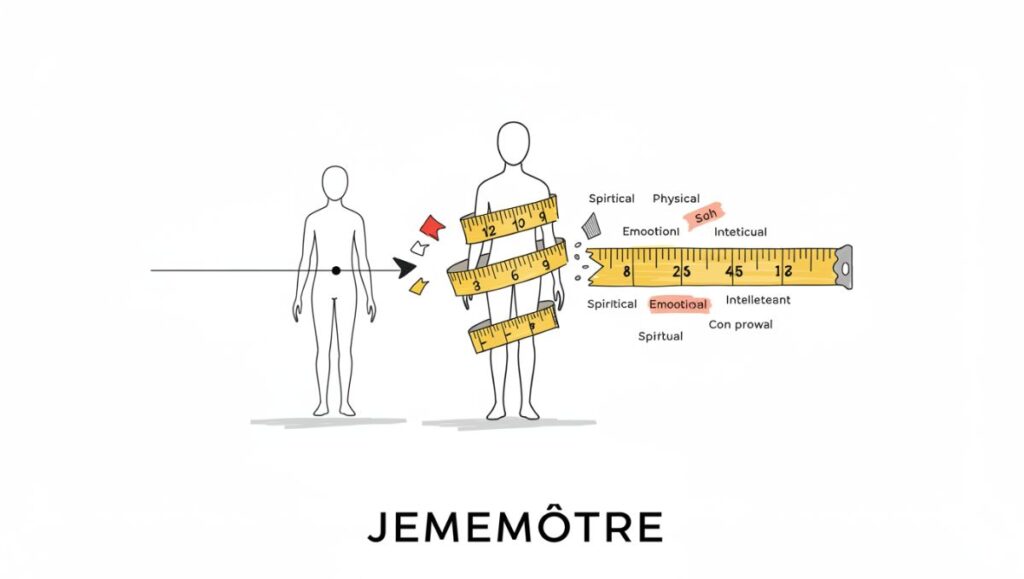
In a world where personal development, self-awareness, and performance measurement are more important than ever, new concepts constantly emerge to help us understand ourselves better. One of these innovative ideas is jememôtre. At first glance, the word may seem unusual or even unfamiliar, but its power lies precisely in its originality.
Derived from French roots, je me (“I myself”) and môtre (a creative variation evoking mettre “to put” or montrer “to show”), jememôtre can be interpreted as “I measure myself” or “I reveal myself through measurement.” It represents a modern approach to self-tracking, self-reflection, and holistic evaluation of one’s life.
Unlike traditional methods that only focus on numbers—such as weight, steps, or financial progress—jememôtre expands the scope to include emotions, values, habits, and personal meaning. It is both a philosophy and a practical framework for achieving balance in modern life.
The Origin and Philosophy Behind Jememôtre
Every concept is born from a need. Jememôtre arises from the human desire to reconcile measurement and authenticity.
-
Measurement: Humans have always measured things to gain control and clarity. From timekeeping to scientific experiments, measuring allows us to progress.
-
Authenticity: On the other hand, self-growth is not only about numbers. Qualities such as empathy, resilience, creativity, and happiness cannot always be reduced to metrics.
Jememôtre proposes a middle path: a way to measure oneself without losing humanity and subjectivity. It’s not about cold statistics but about meaningful indicators that reflect the person you truly are.
At its core, jememôtre encourages us to ask:
-
What aspects of my life truly define me?
-
How do I evaluate my progress in a way that respects my individuality?
-
Can measurement be an act of self-love rather than self-criticism?
The Four Dimensions of Jememôtre
To make the philosophy practical, jememôtre can be divided into four interconnected dimensions. These dimensions ensure that measurement goes beyond numbers and encompasses the whole human experience.
1. The Physical Dimension
This is the most familiar part of measurement—tracking aspects such as health, exercise, sleep, and nutrition. However, in jememôtre, the physical dimension is not only about achieving perfection or external standards. Instead, it’s about listening to the body and noticing patterns that influence well-being.
Examples:
-
Recording energy levels during the day.
-
Noting how different foods affect mood.
-
Observing the relationship between rest and productivity.
2. The Emotional Dimension
Feelings are often ignored in traditional metrics, but jememôtre insists on giving them a central place. Emotions are signals that guide decision-making and personal fulfillment.
Practices may include:
-
Keeping an emotional journal.
-
Using a color-coded mood scale.
-
Reflecting on triggers of stress, joy, or calmness.
3. The Intellectual Dimension
Learning, curiosity, and creativity are signs of growth that numbers alone can’t capture. Jememôtre encourages measuring intellectual vitality by observing how often you engage in stimulating activities.
Indicators may be:
-
Number of books read or new skills learned.
-
Quality of conversations.
-
Frequency of innovative ideas or problem-solving moments.
4. The Spiritual or Meaning Dimension
Finally, jememôtre recognizes the importance of values, purpose, and inner peace. Measuring meaning doesn’t imply quantifying faith but rather checking alignment between daily actions and personal values.
Reflection points:
-
Did I live today according to what matters most to me?
-
Am I aligned with my long-term vision?
-
Did I experience gratitude or connection?
Tools and Practices of Jememôtre
Though abstract, jememôtre can be applied with simple tools:
-
Personal Journals: Writing daily reflections combining physical data (steps, sleep hours) with emotional notes.
-
Visualization Boards: Creating charts or mind maps that show balance across the four dimensions.
-
Digital Apps: Adapting health or productivity apps to also track subjective measures like mood, creativity, or values alignment.
-
Weekly Rituals: Setting aside time for self-assessment, asking “What did I learn? How did I feel? Where did I stay true to myself?”
The strength of jememôtre lies in flexibility: each person designs their own system. There is no “universal score,” only personal relevance.
The Benefits of Practicing Jememôtre
Self-Awareness
By engaging with multiple dimensions, individuals gain a holistic view of their lives. They see not only progress but also imbalances that require attention.
Motivation and Balance
Unlike rigid self-tracking, jememôtre inspires motivation because it honors emotions and values. It prevents burnout by showing that success isn’t only about output.
Personal Growth
Jememôtre acts as a compass. Over time, patterns emerge, revealing strengths, recurring challenges, and growth opportunities.
Resilience
Measuring compassionately develops resilience. Instead of punishing ourselves for “failures,” we learn to interpret them as signals and adapt accordingly.
Real-Life Applications of Jememôtre
In Education
Teachers can use jememôtre to help students reflect not only on grades but also on creativity, collaboration, and curiosity.
In Business
Companies adopting jememôtre may track employee well-being alongside productivity. This creates healthier, more innovative workplaces.
In Personal Life
Individuals use jememôtre to check life balance—whether relationships, health, work, and values are aligned.
Challenges and Misconceptions
Like any philosophy, jememôtre comes with challenges:
-
Overcomplication: Some may try to measure everything, missing the point of simplicity.
-
Subjectivity: Because it values personal indicators, critics may argue it lacks scientific rigor.
-
Consistency: The practice requires regular reflection, which can be hard in busy lifestyles.
However, these challenges can be mitigated by focusing on quality over quantity and remembering that the purpose is not perfection, but awareness.
The Future of Jememôtre
As digital tools evolve, jememôtre could shape the next generation of self-quantification systems. Imagine apps that combine biometric data with journaling prompts, or AI companions that help individuals balance their four dimensions.
In an era where mental health and authenticity are increasingly valued, jememôtre offers a human-centered alternative to the quantified-self movement. It represents the next step: a compassionate, holistic self-measurement philosophy for modern life.
Conclusion
Jememôtre is more than a word—it’s a mindset. It invites us to measure not only our actions but also our emotions, thoughts, and values. By embracing the four dimensions of physical, emotional, intellectual, and spiritual growth, individuals can create a personalized system of self-reflection.
In a society often dominated by external standards, jememôtre empowers us to define our own progress, guided by authenticity and meaning. It is a philosophy that balances numbers with humanity, pushing us to live more consciously and compassionately.