
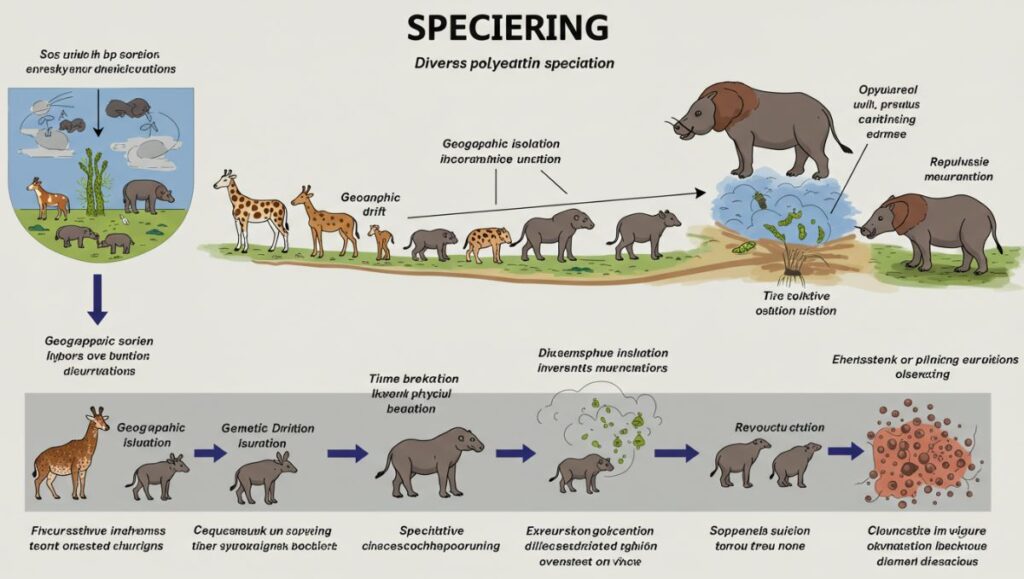
Speciering is a biological process that explains how one species splits into two or more distinct species over time. It is a fundamental concept in evolutionary biology and one of the driving forces behind Earth’s biodiversity. Without speciering, the natural world would not hold the incredible variety of plants, animals, and microorganisms that we see today.
This article explores what specie-ring means, its main types, examples, and why it plays such an important role in both science and conservation.
What Is Speciering?
Speciering refers to the evolutionary process of species formation. When populations of the same species become isolated — either geographically, behaviorally, or genetically — they begin to diverge. Over many generations, these differences accumulate until interbreeding is no longer possible, resulting in the creation of new species.
Types of Speciering
1. Allopatric Speciering
-
Occurs when populations are physically separated by natural barriers such as rivers, mountains, or oceans.
-
Over time, isolation reduces gene flow, leading to genetic divergence.
-
Example: Darwin’s finches evolving separately on different Galápagos Islands.
2. Sympatric Speciering
-
Happens within the same geographic area.
-
Often caused by behavioral changes, ecological preferences, or chromosomal mutations.
-
Example: Insects adapting to different host plants while living in the same region.
3. Peripatric Specie-ring
-
A small group becomes isolated at the edge of a population’s range.
-
Founder effects and genetic drift play a large role.
-
Example: Polar bears diverging from brown bears in northern regions.
4. Parapatric Speciering
-
Populations remain adjacent but live in different ecological niches.
-
Some gene flow occurs, but adaptation to different environments drives separation.
-
Example: Certain grasses adapting to contaminated soils near mining areas.
Mechanisms Behind Speciering
Several evolutionary forces contribute to specie-ring:
-
Mutation – Introduces new genetic traits.
-
Natural selection – Favors beneficial adaptations.
-
Genetic drift – Random changes in small populations.
-
Reproductive isolation – Prevents successful mating between populations.
Reproductive isolation can be prezygotic (before fertilization, e.g., different mating calls) or postzygotic (after fertilization, e.g., sterile hybrids like mules).
Famous Examples of Speciering
-
Darwin’s finches – Different beak shapes suited to different diets.
-
Cichlid fish in African lakes – Hundreds of new species formed in short evolutionary time.
-
Horses and donkeys – Separate species producing sterile hybrids, showing clear reproductive isolation.
Importance of Speciering
Understanding specie-ring has applications in:
-
Conservation biology – Protecting genetically distinct species.
-
Agriculture – Managing evolving pests and crops.
-
Medicine – Tracking the evolution of pathogens.
-
Climate change research – Predicting how species adapt to changing environments.
Conclusion
Speciering is the engine of biodiversity, explaining how new species arise and why life on Earth is so diverse. By studying specie-ring, scientists can better understand evolution, protect endangered species, and predict how organisms may continue to adapt in the future.